Traditionally, surgical treatment has been the mainstay of treating tympanic membrane perforations. A recent study published in Otology & Neurotology by Dr. Hamid Djalilian and his team found that office procedures are very successful at closing tympanic membrane perforations that are less than 50% in size. In that initial study, Dr. Djalilian’s team found that 63.7% of a cohort of 204 ears (169 patients) had complete closure with paper patch technique using trichloracetic acid and instrumentation of the perforation edges for perforations under 50% in size. A subsequent study recently published in Otolaryngology-Head and Neck Surgery examined 81 ears of patients who had not achieved complete closure with initial paper patch myringoplasty in the office. Some of this cohort had paper patch a second time and another cohort had paper patch with adjunctive serum drops.
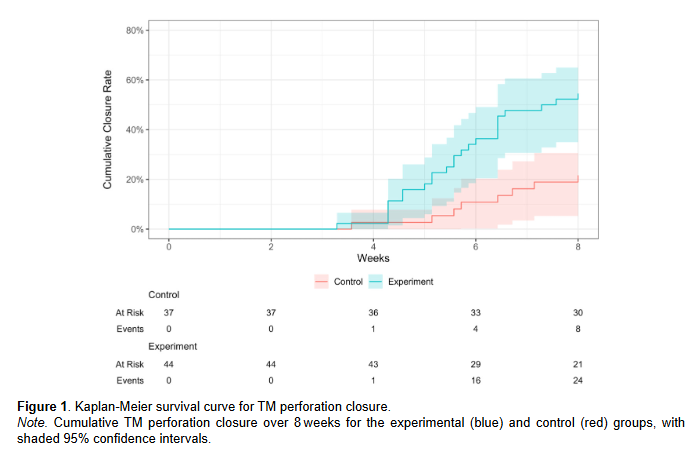
In this technique, blood is taken by the patient and spun at 5000 RPM for 15 minutes. The supernatant (serum) is mixed with ofloxacin drops and provided to the patient to use for the next six weeks. The paper patch technique was the same as the previously performed. In this cohort, 54.5% of ears achieved closure with adjunctive serum drops. When paper patch alone without serum drops was used for the second procedure, the closure rate was 21.6%. If adjunctive serum drops were used as part of the second procedure, the total closure rate of perforations using office procedures using an initial paper patch and if the first procedure was unsuccessful, a subsequent paper patch with adjunctive serum drops to a much higher rate.
Overall, the patients achieved an 78% total closure rate of perforations with one or two office procedures.